
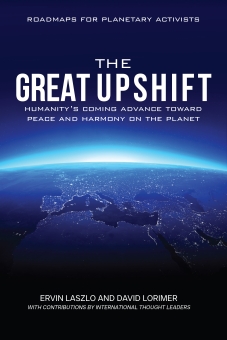
During the last years of the Cold War, I had a front row seat as a senior systems designer in the defense industry to one of the most frightening times in the history of the world, and the thinking that led to it. During the last years of the most potentially lethal, yet undeclared, war in human history, the superpowers of the United States and the former Soviet Union did something that seems unthinkable to any rationally minded person today. They spent the time, energy, and human resources to develop and stockpile somewhere in the neighborhood of 65,000 nuclear weapons—a combined arsenal with the power to microwave the Earth, and everything on it, many times over.

The rationale for such an extreme effort stems from a way of thinking that has dominated much of the modern world for the last 300 years or so, since the beginning of the scientific era. It’s based in the false assumptions of scientific thinking that suggest we’re somehow separate from the Earth, separate from one another, and that the nature that gives us life is based upon relentless struggle and survival of the strongest. Fortunately, new discoveries have revealed that each of these assumptions is absolutely false. Unfortunately, however, there is a reluctance to reflect such new discoveries in mainstream media, traditional classrooms and conventional textbooks. In other words, we’re still teaching our young people the false assumptions of an obsolete way of thinking based on struggle, competition, and war.

While we no longer face the nuclear threat that we did in the 1980s, the thinking that made the Cold War possible is still in place. This fact is vital to us all right now for one simple reason: For the first time in human history the future of our entire species rests upon the choices of a single generation—us—and the choices are being made within a small window of time—now. The best minds of our time are telling us that we must act quickly to avert the clear and present danger of a host of new crises that are converging in a “bottleneck” of time covering the first years of the 21st Century.

The journal Scientific American released a special edition (vol. 293, no. 3, September 2005) to bring the world up to speed on the critical situation we find ourselves in today. The title, Crossroads for Planet Earth, says it all. The way we solve the simultaneous crises—such as our response to climate change, the unsustainable and growing levels of extreme poverty, the emergence of new diseases, the growing shortages of food and fresh drinking water, the growing chasm between extreme wealth and extreme poverty, and the unsustainable demand for energy—will chart the destiny, or seal the fate of our global family that is estimated to reach a staggering 8 billion by 2025.

[Continue reading…]

Share

{ 4 comments }

The Role of Spirituality in a Worldshift

by Bruce Lipton on May 30, 2011

We are truly living in exciting times. The challenges and crises facing the world today are portents of imminent change in civilization. We are on the threshold of an incredible global evolutionary shift.

The current panoply of global crises collectively reveals we are facing our own extinction. Scientists acknowledge that the current degradation of the environment and the massive loss of species are evidence that we are deep into the sixth mass extinction to hit Earth since the origin of life. Unlike the first five massive die-offs, attributed to physical causes such as life-destroying geological upheavals and the impact of comets and asteroids, the current wave of extinctions is due to a source much closer to home: human behavior. Our way of life is wreaking havoc in the global community and our survival is now in question.

Crises are harbingers of evolution. Albert Einstein wisely proffered, “We cannot solve the problems with the same thinking that created them.” Consequently, the planet’s hope and salvation lies in the adoption of revolutionary new knowledge being revealed at the frontiers of science. This new awareness is shattering old myths and rewriting the “truths” that shape the character of human civilization.

New science revises four fundamental beliefs that shape civilization. These flawed assumptions include: 1) The Newtonian vision of the primacy of a physical, mechanical Universe; 2) Genes control biology; 3) Evolution resulted from random genetic mutations; and 4) Evolution is driven by a struggle for the survival-of-the-fittest. These failed beliefs represent the “Four Assumptions of the Apocalypse,” for they are driving human civilization to the brink of extinction.

Modern science is predicated on “truths” verified through accurate observation and measurements of physical world phenomena. Science ignores the spiritual realm because it is not amenable to scientific analysis. As importantly, the predictive success of Newtonian theory, emphasizing the primacy of a physical Universe, made the existence of spirit and God an extraneous hypothesis that offered no explanatory principles needed by science.

In the wake of Newtonian theory, with the Hand of God out of the way, society has been preoccupied with dominating and controlling Nature. Darwin’s theory further exacerbates the situation by suggesting that humans evolved through the happenstance of random genetic mutations. Accordingly, we evolved by pure “chance,” which by extension means: without an underlying purpose for our existence. Darwinian theory removed the last link between God, spirit and the human experience.

[Continue reading…]

Share

{ 5 comments }

The most fundamental question facing humanity is this: At its foundations, is the universe dead or alive? In short, was Plato correct when, more than two thousand years ago, he said: “The universe is a single living creature that encompasses all living creatures within it.” 

We can begin to answer this question by turning to both science and the world’s wisdom traditions. Science now regards our universe as: 1) almost entirely invisible (96 percent of the known universe comprised of invisible energy and matter), 2) completely unified and able to communicate with itself instantaneously in ways that transcend the limits of the speed of light, 3) sustained by the flow-through of an unimaginably vast amount of energy, and 4) having freedom at its deepest, quantum levels. While not proving the universe is alive, these and other attributes from science do point strongly in that direction.

When we turn to the world’s wisdom traditions and ask how they regard the universe, we find a stunning consensus that the universe is a continuously regenerated, living presence:

“God is creating the entire universe, fully and totally, in this present now. Everything God created . . . God creates now all at once.”

           —Meister Eckhart, Christian mystic

“My solemn proclamation is that a new universe is created every moment.”

           —D.T. Suzuki, Zen teacher

“The Tao is the sustaining Life-force and the mother of all things; from it, all things rise and fall without cease.”

           —Tao Te Ching, Taoism

“God keeps a firm hold on heavens and earth, preventing them from vanishing away.”

           —Islam, Koran

“Evolution presupposes creation. . . creation is an ever-lasting process—a creation continua.”

           —Pope John Paul II

These quotes just begin to describe the profound aliveness of the universe as seen through the lens of the world’s wisdom traditions. 

What difference does it make if the universe is dead or alive at its foundations? When children are starving, climate is destabilizing, oil is dwindling, and population is growing, why is it important to put our attention here? Here are a few reasons why aliveness makes a profound difference.

[Continue reading…]

Share

{ 8 comments }

Spiritual Practices for This Time of Crisis

by Joanna Macy on May 30, 2011

At this turning in humanity’s journey, science and spirituality converge, and we can glimpse new possibilities for a life-sustaining civilization. But the going is rough. One mega-disaster follows another. Economic, political, and ecological systems spin out of control, in what David Korten aptly calls the Great Unraveling. 

As the rug is progressively pulled out from under us, it is easy to panic, and even easier to simply shut down. These two instinctive reactions—panic and paralysis—are the roadside ditches that border our pathway to a livable future. To fall into either one is the greatest of all the dangers we face, for they deaden the heart and derail the mind. If ever we needed spiritual practices and disciplines for staying alert and connected, it is now.

The greatest gift we can give our world is our presence, awake and attentive. What can help us do that? Here, drawn from ancient religions and Earth wisdom traditions, are a handful of practices I have learned to count on. 

1.  Breathe

Our friend the breath is always with us. When we pay attention to its flow, it merges mind with body, and connects inner world with outer world. Mindfulness of breathing-in and breathing-out can center and steady you. 

“Feel how your breathing makes more space around you,” writes the poet Rilke.

“Pure, continuous exchange with all that is, flow and counterflow where rhythmically we come to be.”

Notice that you are not deciding each time to exhale or inhale; it’s rather that you’re being breathed. Breathed by life. And so are all the other animals, and plants too, in vast rhythms of reciprocity. Feel that web enlivening you and holding you.

The felt flow-through of matter/energy brings a measure of ease, and opens us to the flow-through of information as well. This lowers our usual defenses against distressing information, and begins to unblock the feedback loops, so we can more clearly perceive what we’ve caused to happen. 

2.  Come from Gratitude

As burning rainforests and dying plankton progressively diminish our oxygen supply, each breath seems more precious. Thankfulness for that precious gift galvanizes us to act, to protect.

With gratitude we affirm our birthright to be here in Earth, endowed with self-reflexive consciousness, the power to choose. To be here in solidarity with each other.  To be a living, intrinsic, blessed part of this living Earth. 

[Continue reading…]

Share

{ 2 comments }

A Path Forward: Embracing our Creative Imagination

by Marilyn Schlitz March 25, 2011

It’s been quite a year—and it’s only March. Extreme political unrest is underway throughout the Middle East. Earthquakes rock New Zealand, China, California, and Japan. Shifting plates and tsunami waves in the Pacific Ocean have nuclear power plants perched on the edge of explosion. Like many, I track these global events through social media. I’m [...]

Share
2 comments Read the complete post →

Entropy, Negentropy and Our Moral Imagination

by James O'Dea March 25, 2011

Scientists are not the only ones these days pointing out the fact that our planetary civilization is hugely entropic: we are burning up useable stuff at ever accelerating rates. China’s latest move to reduce exporting rare minerals used for all our tech toys from ipads to cell phones is just our most recent reminder that [...]

Share
4 comments Read the complete post →

Guiding Our Inner Evolution

by Masami Saionji March 25, 2011

Why is it that humanity has not yet made the transition from a materialistic society to one based on principles of harmony, respect, and love? I believe it is because most human beings have been living in ignorance of the truth. We may have acquired much knowledge and information, but the majority of people on [...]

Share
3 comments Read the complete post →

Changing Direction

by Jagdish Gandhi March 25, 2011

The world is going through a crisis. Although most governments have pledged themselves to help develop a peaceful, sustainable and socially just world, still we seem to be going in the opposite direction. Climate scientists have been warning that we are about to cross the tipping point yet deforestation and environmental degradation continue unchecked. It [...]

Share
1 comment Read the complete post →